On the morning of 12 November, the Ministry of Agriculture and Environment held the Ceremony celebrating the 80th Anniversary of the Agriculture and Environment sector and the 1st Patriotic Emulation Congress. This special occasion was not only an opportunity to reflect on a long journey marked by hardship and notable contributions but also a moment to inspire pride in tradition, foster a spirit of renewal, and reinforce a sense of responsibility in a new era.
The Agriculture and Environment sector becomes the pillar of the economy and the baseline of livelihoods
Delivering the directive speech at the ceremony, General Secretary To Lam affirmed that the Agriculture and Environment sector has always accompanied the nation, serving as a pillar of the economy and playing a crucial role in livelihoods, social security, and the long-term development of the country.
He highly valued the emulation spirit and dedication of the sector across 80 years - from the difficult days following the August Revolution of 1945 through wartime, natural disasters, and the challenges of peacetime. The General Secretary commended the sector’s more recent achievements, especially during the 2020–2025 emulation movement, when it overcame numerous difficulties to sustain growth momentum and contribute significantly to macroeconomic stability and social welfare.
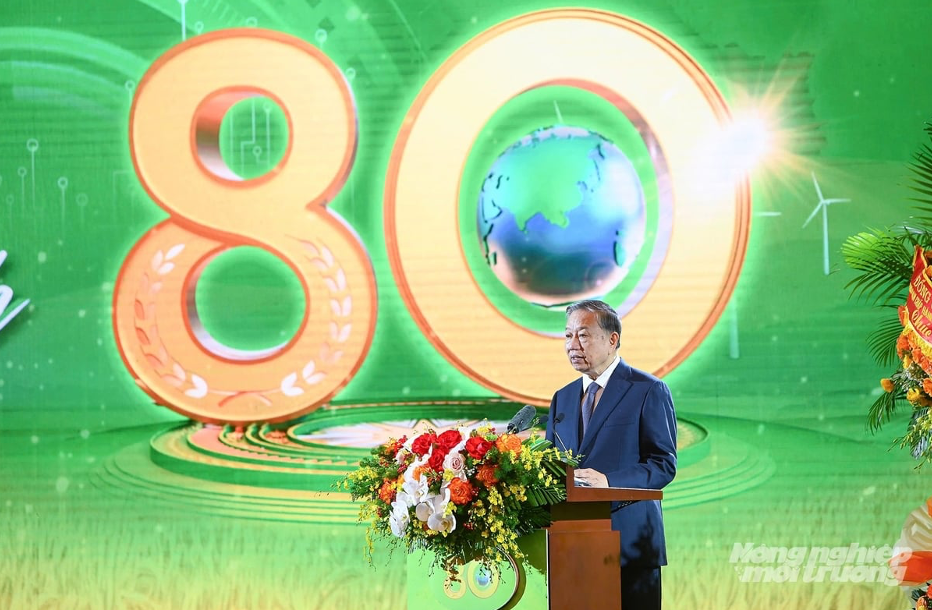 General Secretary To Lam speaks at the ceremony. Photo: Tung Dinh.
However, General Secretary To Lam also pointed out major challenges, including conflicts of interest between economic development and environmental resource protection, pressure on water sources, pollution, and climate change. He noted that many rural areas remain disadvantaged and that management mechanisms are still insufficient in several places.
Regarding future orientations, he called on the entire sector to uphold revolutionary traditions by renewing thinking, acting decisively, and daring to innovate and take responsibility. He stressed the need for strengthened solidarity and the full use of wisdom and creativity. In particular, land must continue to be identified as a special national asset owned by the people and uniformly managed by the State. It must be used for the right purpose, efficiently, publicly, and transparently, without loss, corruption, or disguised privatization. He urged the establishment of mechanisms to control power and ensure transparency in planning, land allocation, leasing, land-use conversion, and resource exploitation to prevent interest groups, corruption, and waste.
Science, technology, innovation, digital transformation, and data must become the key driving forces. The General Secretary emphasized putting science and technology at the heart of agricultural production, from plant and livestock varieties, biotechnology, and automation to traceability, logistics, and digital commerce. He encouraged the “scientist-enterprise-cooperative-farmer” model to work together in value chains and stressed that agricultural extension must be tied to fields and production facilities rather than remaining just slogans.
The sector must also prioritise planning, managing, and using resources efficiently while protecting the living environment. The Agriculture and Environment sector needs to manage resources strictly, regulate fairly, restore river and lake ecosystems and groundwater, and control pollution. It must proactively adapt to climate change, especially in the Mekong Delta, North Central Coast, Central Highlands, and coastal regions. This includes upgrading irrigation systems, dykes, and reservoirs, and applying technologies for flood, landslide, and saltwater intrusion warnings. The sector must also restore protection forests and mangroves, conserve biodiversity, and treat nature as a partner in development. Strong coordination is required to resolve environmental pollution hotspots in major cities, industrial zones, craft villages, and river basins.
General Secretary To Lam emphasized restructuring the agricultural sector toward ecology and high added value, shifting from extensive to intensive development, from increasing output to enhancing quality, value, and branding. He called for bold development of ecological, organic, and circular agriculture using high technology. Production must be linked with deep processing and modern trade. Building national brands, expanding markets, and integrating deeply into global agricultural value chains are essential steps. The goal is to develop a model new-rural ecosystem with synchronized infrastructure, a strong cultural identity, a clean environment, stable security, and a civilized rural society.
He concluded with a clear message: despite the achievements, heavy responsibilities lie ahead. The sector must set higher goals to continue contributing meaningfully to national development, particularly in the context of international integration, green transition, and climate change.
The Agriculture and Environment to mark the history of the nation
Speaking at the celebration, Minister of Agriculture and Environment Tran Duc Thang expressed deep gratitude to generations of officials, civil servants, and employees who have contributed over eight decades. They have devoted themselves not only to managing production but also to protecting resources and the environment, advancing rural development, and serving the nation.
Recalling history, Minister Thang highlighted the war years (1945–1975), when, amid bombs and natural disasters, the agricultural sector maintained production under the motto “plough in one hand, gun in the other,” supporting the front lines and ensuring food for the people. After reunification, despite an exhausted economy and devastated infrastructure, the sector quickly recovered, building cooperatives, agricultural and forestry farms, investing in irrigation, and restoring production, reflecting the nation’s aspiration for agricultural autonomy.
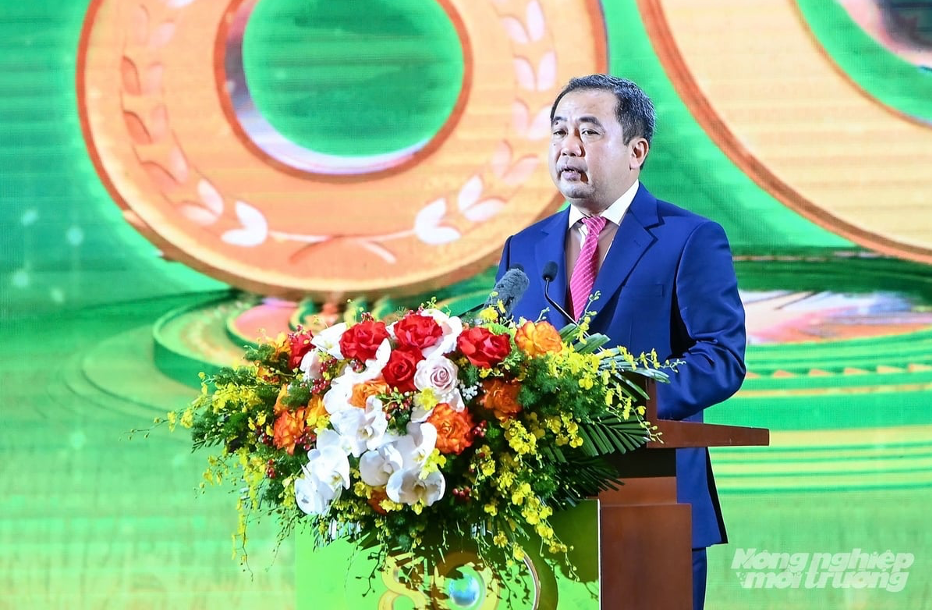 Minister Tran Duc Thang speaks at the ceremony to celebrate the 80th anniversary of the industry and the first Patriotic Emulation Congress. Photo: Tung Dinh.
He reviewed the renovation period since 1986, noting that the contract mechanism, the Land Law, the application of science and technology, and the new-rural development program laid the foundation for modern, high-efficiency agriculture. Thanks to these efforts, Vietnam has not only ensured food security but has also become a major agricultural exporter with many flagship products on the global market.
The Minister also emphasized the strategic significance of the merger of the Ministry of Agriculture with the Ministry of Natural Resources and Environment, effective March 1, 2025. This integrated governance model, he noted, is leaner, more efficient, and aligned with accountability in managing national resources.
As the world shifts firmly toward a green, circular, and low-carbon economy, Vietnam has also set ambitious goals. These include advancing ecological agriculture, using resources efficiently, applying science and technology, and integrating environmental protection into economic development.
Regarding future directions, Minister Thang identified several key tasks. The first is improving institutions and modern governance. The Ministry of Agriculture and Environment must review and comprehensively amend policies related to land, water, forests, the environment, and climate. It must adopt a management model based on regions, basins, and ecosystems, with decentralization accompanied by accountability.
The sector will develop ecological agriculture, a green and circular economy, and shift from extensive growth to high added value based on science, technology, and innovation. It will proactively manage resources, protect ecosystems, and develop a low-carbon economy. One important direction is accelerating digital transformation and scientific–technological capacity, creating breakthroughs in governance, production, environmental monitoring, and traceability to improve productivity and sustainability.
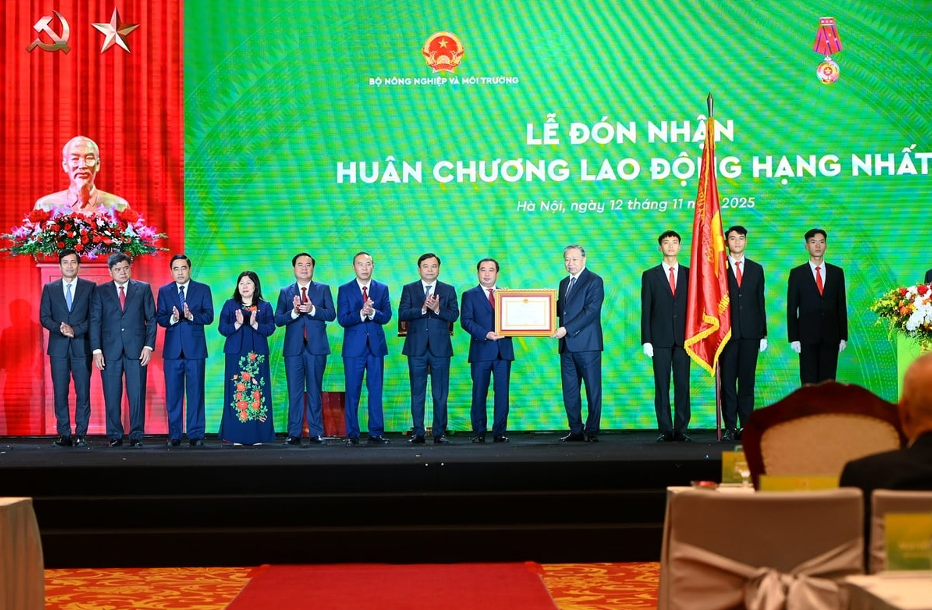 General Secretary To Lam, on behalf of the Party and State leaders, presents the First Class Labor Medal to the Ministry of Agriculture and Environment. Photo: Tung Dinh.
The Agriculture and Environment sector will also strengthen international cooperation to learn, attract resources, and participate more deeply in global initiatives on net-zero emissions and resource protection.
On this occasion, Minister Thang launched a sector-wide emulation movement under the spirit of “Tradition - Innovation - Development - Sustainability.” He called on civil servants, employees, farmers, and businesses to transform traditional pride into action, turning aspirations into concrete results in the journey toward a greener, more sustainable future.
Minister Tran Duc Thang affirmed that the entire sector must continue promoting patriotic emulation, encouraging innovation at the grassroots level, and rewarding individuals fairly and appropriately. He stressed that this spirit will be a powerful motivator for the sector to overcome challenges and fulfil strategic tasks in the new era.