The Viet Nam Coconut Association worked with the International Finance Corporation (IFC) and businesses to promote the supply chain, enhance competitiveness, and develop the coconut industry sustainably.
On December 1, the Viet Nam Coconut Association held a working session with the International Finance Corporation (IFC). Also attending were representatives of coconut industry businesses involved in the sustainable supply chain, such as Betrimex, Beinco, Thabico, Vina T&T, and Cho Gao Coconut Cooperative.
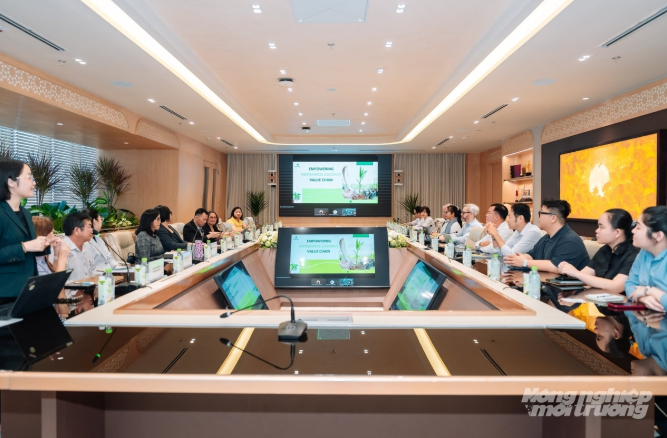 The Viet Nam Coconut Association held a working session with the International Finance Corporation (IFC). Photo: Vuong Thinh.
At the working session, the parties discussed building support programs for Viet Nam's coconut industry to enhance the supply value chain, strengthen competitiveness, and assist businesses in achieving sustainable development.
Mr. Cao Ba Dang Khoa, Vice Chairman and Secretary-General of the Viet Nam Coconut Association, stated that prior to the merger, Viet Nam had 35 provinces with coconut cultivation areas. After the merger, Viet Nam currently has 18 coconut-growing provinces with an area of over 200,000 hectares, yielding more than 2.26 million tons of fruit annually, mainly concentrated in the Mekong Delta and the Central Coast.
The whole country has 145 processing factories and approximately 600 businesses operating in the coconut industry. Export turnover in 2024 reached $1.089 billion USD. To date, 32 businesses have developed raw material areas following specialized cultivation models or by linking with households, covering 68 hectares of coconut certified with international organic standards.
 Mr. Cao Ba Dang Khoa, Vice Chairman and Secretary-General of the Vietnam Coconut Association, provided information on the overview of Vietnam's coconut industry. Photo: Vuong Thinh.
According to the Secretary-General of the Viet Nam Coconut Association, Viet Nam's coconut industry is strongly shifting from inorganic to organic and biological fertilizers, thereby improving fruit quality and stabilizing production. The application of technology in processing, from coconut oil, canned coconut water, coconut cream, coconut milk powder, and coconut shell charcoal to coir mats and various byproducts, contributes to enhancing the coconut industry's value.
However, in the last two years, the price of raw coconut materials in Viet Nam and Asia has experienced significant volatility. Therefore, at the Ministerial-level meeting of the International Coconut Community (ICC) on October 21st, Viet Nam proposed the establishment of an Asian regional raw coconut price information exchange to control price fluctuations and protect the interests of producers.
"The Viet Nam Coconut Association wishes to expand cooperation with the international coconut community and other coconut-growing nations," said Mr. Cao Ba Dang Khoa, adding that the Viet Nam Coconut Association has implemented a plan to build a raw material supply chain linked with financial support from credit institutions and trade promotion programs, aiming to increase the value and competitiveness of Vietnamese coconut products.
Regarding fresh coconut, the representative of the Viet Nam Coconut Association stated that there is still a lack of cultivation area planning and insufficient information, making it difficult for businesses to build long-term supply chains. Consequently, the brand of Vietnamese fresh coconut has yet to establish a firm position in the international market.
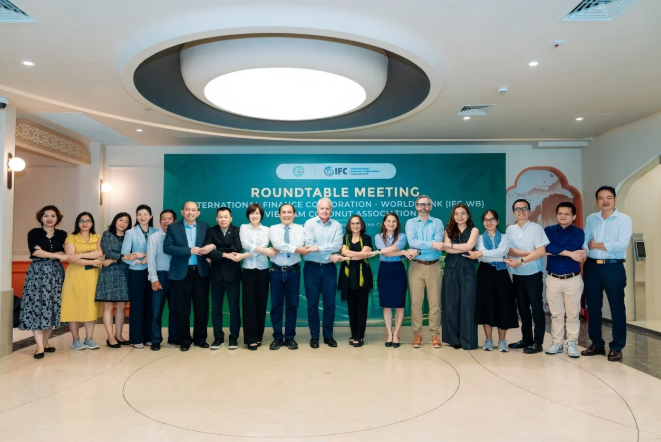 Following the working session, the IFC will develop a specific program to support businesses in Viet Nam's coconut industry during the 2026-2030 period. Photo: Vuong Thinh.
Ms. Nguyen Thi Kim Thanh, Chairwoman of the Viet Nam Coconut Association, stated that the Association is researching the introduction of suitable medicinal herbs into coconut groves to reduce pests and diseases, increase biodiversity, and create a circular value chain while still complying with organic standards.
The Chairwoman emphasized that the coconut industry is moving towards building intangible value and a national brand for the Vietnamese coconut tree, while simultaneously meeting environmental goals and ensuring Net Zero commitments. Meanwhile, many coastal provinces affected by saline intrusion are shifting their crop structure, choosing coconut as the key crop due to its good adaptability.
The Viet Nam Coconut Association is promoting workshops and policy recommendations to form large, concentrated coconut raw material zones instead of small, scattered family plots, and also proposing a mechanism for developing social housing for coconut-growing communities.
With this sustainable development orientation, Ms. Nguyen Thi Kim Thanh expressed the desire for IFC to support Viet Nam's coconut industry regarding livelihoods, policies, and programs aimed at stabilizing the lives of people in coconut-growing areas.
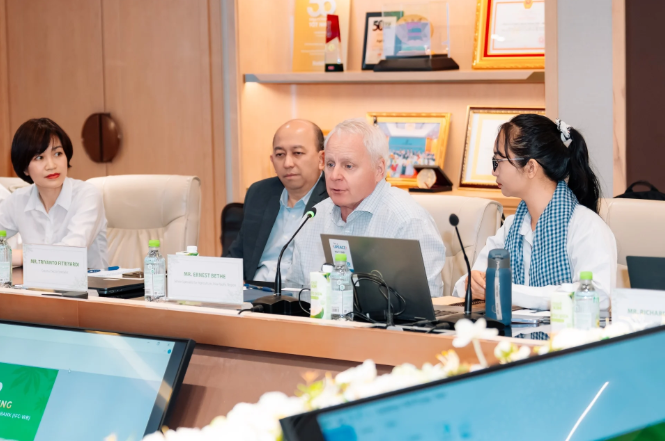 Mr. Ernest Bethe, Lead Specialist for Agriculture, Asia-Pacific Region, provided information at the working session. Photo: Vuong Thinh.
At the working session, the IFC representative introduced the role of the IFC in supporting private sector activities to build the coconut industry's value chain, enhance export competitiveness, and foster sustainable development. This contributes positively to the goal of sustainable growth and elevating the position of Vietnamese enterprises within the fruit supply chain in general, and the global coconut industry in particular.
Following the working session, the delegation will conduct a field survey of the raw material areas and production facilities of Betrimex and other businesses. Concurrently, the IFC will develop a specific program to support Viet Nam's coconut industry enterprises during the 2026-2030 period, aiming to enhance the competitiveness of Vietnamese coconut products in the international market and create a new sustainable coconut agri-industrial foundation on the economic map.
The International Finance Corporation (IFC) is a member of the World Bank Group, established in 1956 to promote economic development and job creation in member countries by financing the private sector through various forms of support capital and concessional loans.